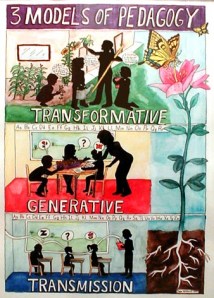
In response to a posting on the UNESCO-UNEVOC e-Forum (a virtual community of Technical and Vocational Education and Training (TVET) practitioners from around the world who share information and knowledge about different aspects of TVET) I have been reflecting on the inequities of our education systems. There are still so many educational environments that continue to advocate the use of a teacher/trainer focussed approach that promotes ‘instructional/transmission’ as opposed to ‘transformational’ learning.
As many of you know, I’ve recently completed my Masters thesis in Education, looking at autobiographical reflection and perspective transformation, using the lens of Jack Mezirow’s Transformative Learning Theory. Through Mezirow I also discovered Stephen Brookfield, Patricia Cranton, Edward Taylor, John Dirkx and a whole collective of inspirational and authentic educators. The research I have undertaken – and the work I do with my own VET (Vocational Education & Training) teachers and students – always brings me back to a transformative approach to learning.
Using this methodology encourages us to examine and contest the unattended assumptions that pervade our thinking, behaviours and practices, and allow us to slowly, thoughtfully, meaningfully shift our thinking and ways of seeing the world. In this model, the teacher/educator/VET practitioner and ‘learner’ share the journey of learning, bringing their very unique skills, knowledge and experience to the learning space. It is achieved through any method that promotes an open and equitable learning space where all are encouraged to think critically and engage in open dialogue and inquiry.
Paulo Freire, a well renowned, radical, Brazilian educator (later to work with Ira Shor) spoke scathingly of what he referred to as the ‘banking’ model of education, where students basically line up to receive the skills and knowledge identified as necessary by a ‘ruling other’ (a teacher, an industry, a governing body of some sort … someone who tells you “This is the way it is.”) This model is also known as ‘bucket education’ … “Line up, hold up your bucket, and I will shovel in the things you need to know … got it?” You are a passive recipient and have no part to play in critiquing the value or practical application of the information provided.
If we are striving to cultivate powerful learning environments where innovative and transforming outcomes are realised for the future of our global community, then it can only be achieved in a way that truly honours and speaks to the incredible strengths that lay within each individual. Carl Rogers and many other authentic educators speak of cultivating our learners so that they can grow in strength and stature like the plants we nurture. This cannot be realised through teacher focussed, ‘banking’ learning environments, only through open, authentic learning spaces where critical inquiry fosters the discovery of personal truths and meaning-making that ultimately lead to world-changing advances founded in the value and integrity of each individual.
Critical reflection and hands-on, experiential inquiry must always underpin the process of learning, or we will only ever create passive little ‘vegetables’ whose incredible strengths and intelligences might never be realised. The world will be so much poorer for this. For what it’s worth, I think teacher-focussed learning environments and their associated tests and exams are magnificently designed to maintain the status quo and hierarchy of the class system.
What do you think?
Follow the link to the interesting and beautiful representation of this transformative approach as illustrated above: http://www.joanwink.com/cp3/3perspectives.php
If you’re interested in reading more on any of the ideas I’ve put forward here, my thesis can be found online at: http://monash.academia.edu/JenniMiles/Papers/866087/Restor_y_ing_lives_autobiographical_reflection_and_perspective_transformation_in_adults_returning_to_study
 Jennifer K Miles